
OEM vs ODM for a Body Care Line: A Buyer's Checklist
A body care brand does not choose between OEM and ODM for the price; it chooses which party will own the fragrance formula and the stability risk. OEM means the formula is yours and the factory reproduces it on every run, while ODM means the factory develops the scent from your brief on its own base. For a first body care line, ODM is normally the faster and cheaper route, but it only works if ownership and exclusivity terms are written down early. Decide the model around documentation and ownership, not around the unit price.
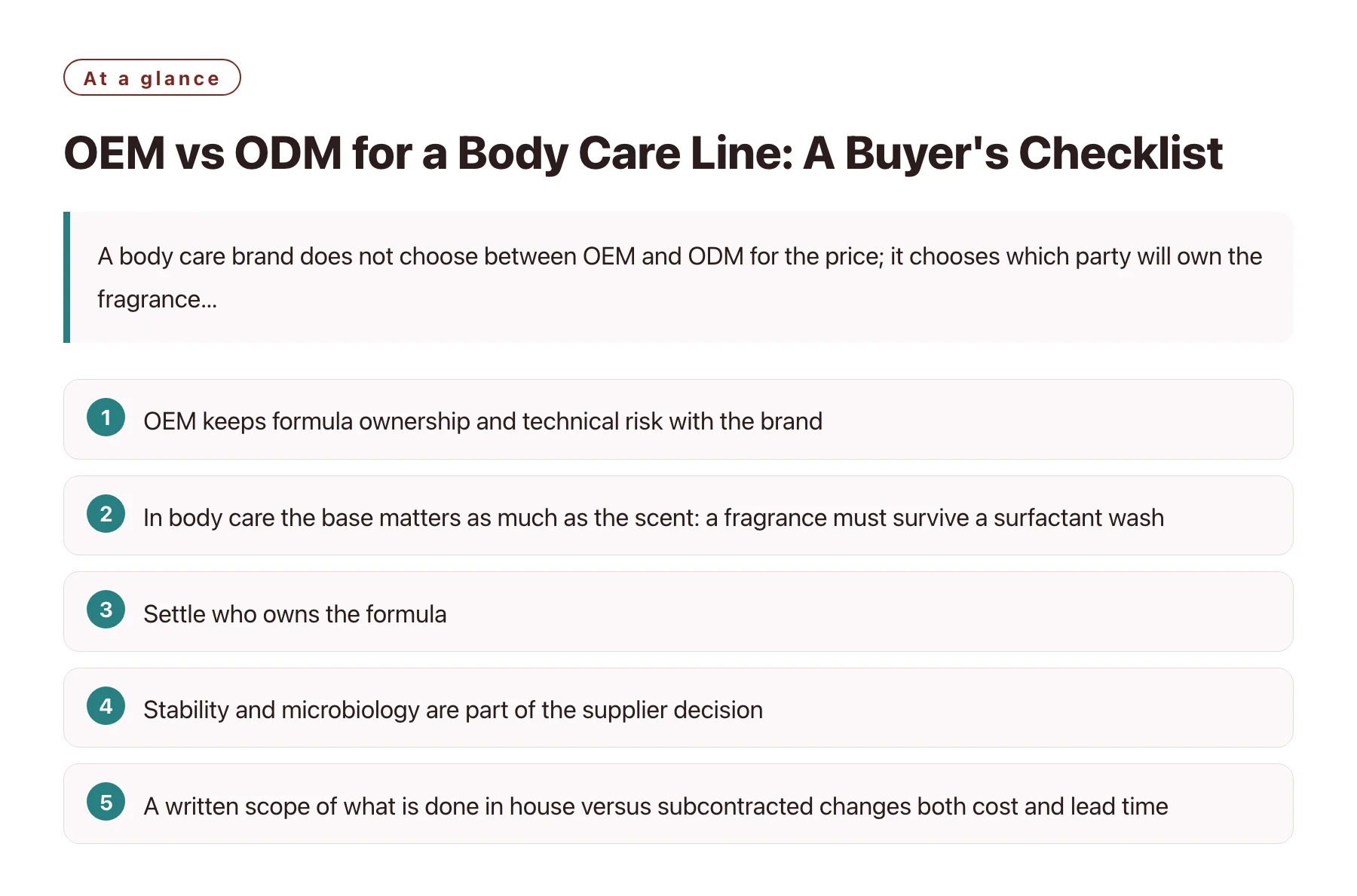
Key takeawaysOEM keeps formula ownership and technical risk with the brand; ODM moves development and most of the risk to the factory. · In body care the base matters as much as the scent: a fragrance must survive a surfactant wash, a lotion emulsion or the texture of a scrub. · Settle who owns the formula, the mould and the design files before the deposit, not after the samples arrive. · Stability and microbiology are part of the supplier decision, because a scent that works in a bottle can fail in a body wash. · A written scope of what is done in house versus subcontracted changes both cost and lead time, so make it part of the quotation.
Most buyers walk into this conversation asking for a price, and that is the least useful first question. In body care the price depends on decisions that have not been made yet: who develops the scent, who adapts it to a wash or a lotion base, who runs the stability tests and which markets the label must satisfy.
The OEM and ODM distinction is a better place to start because it sorts the project into two very different shapes. Once the shape is clear, the checklist below takes ten minutes instead of ten meetings.
Start with the product, not the model
A body wash, a body oil and a hand cream are different projects even when they share one scent story. They use different bases, different preservation strategies and different fill processes, so the model decision only makes sense after the format is fixed. Decide the format first and the model second.
The rinse-off and the leave-on split
Body wash and shower gel are rinse-off products; lotion, body oil and hand cream stay on the skin. The two families differ in formulation, in how the fragrance behaves and in how allergens must be labelled. A supplier that has made both will flag the difference; a supplier that only quotes fine fragrance may discover it with you, later and at your cost.
Where the model shows up
Under OEM, you arrive with a formula, or at least a specification detailed enough to build one, and the factory's job is repeatability. Under ODM, the factory develops the scent from a brief, often starting from accords and bases it already runs, and the development risk sits on its side of the table.
The cleanest way to compare the two routes is to send one brief to a supplier that can quote both, for example a manufacturer that supports OEM and ODM, because the difference then shows up inside the same line items.
The checklist, row by row
| Question | OEM | ODM | Why it matters for body care |
|---|---|---|---|
| Who develops the fragrance | You or your perfumer | The factory, from your brief | Decides whether the scent can ever be exclusive |
| Who runs stability and micro tests | You arrange and pay | Factory, built into the brief | A scent that fails in a surfactant base is a formula problem, not a filling problem |
| Who owns the formula and the mould | You hold both | Factory, unless buy-out terms are agreed | Ownership is what you exercise if you switch factories |
| Paperwork load on the brand | Higher: you supply specs and test reports | Lower: the factory keeps the file | Your market may still require a product information file |
| Easiest first order | When the formula is already proven | When speed matters more | Either way the first run is a process test |
Read the fourth row twice: the paperwork load is the quietest difference between the two models.
Ownership and documentation to pin down
Three clauses that cost nothing at signing
Formula ownership, mould ownership and an exclusivity window are clauses, not chemistry. Decide who holds each and for how long, and write it on one page. If the relationship ended next season, this page is what lets you take the product to another maker and reproduce it exactly.
Collect the file, not just the product
Before the first bulk order, ask for the batch record, the allergen declaration and a statement that the fragrance sits inside current industry restrictions. The IFRA standards library is the published reference most suppliers quote for that statement, and it is worth knowing what it covers before your retailer asks about it [1].
If you sell into the EU, the responsible person and the product information file are legal requirements rather than a favour, and the Commission describes the obligations in plain terms on its cosmetics pages [2].
One maker or two
For a first line, the useful habit is to keep the scent, the base and the filling under one programme, because every handover between suppliers is a place where the reference drifts.
You can verify a lot of this yourself: a maker that publishes its scope and certifications on its site is cheaper to audit than one that answers by email. The scope published on the official Xuelei website, for example, is the kind of thing you can check in five minutes rather than in five calls.
Put four things on one page before any deposit: the model, the owner of the formula and mould, the sample approval reference and the documentation list. Everything else in the project can move. Those four should not.
Sources
- IFRA Standards Library (International Fragrance Association) —— The IFRA Standards Library lists the restrictions the fragrance industry applies to individual fragrance ingredients, based on safety assessments; it is the reference point for compliant fragrance formulation.
- European Commission: Cosmetics in the EU —— The European Commission's overview of EU cosmetics rules, including the responsible person, product information file and safety report requirements.
Frequently asked questions
Is ODM right for a first body care line?
Usually yes. Development is cheaper and faster because the factory reuses existing accords and bases, and the brand tests the category before committing to a custom formula. The condition is that exclusivity and ownership are written down before signing.
What makes a body wash different from a perfume when choosing a factory?
The base. A body wash has to stay stable in a surfactant system, preserve correctly and keep the scent behaving after months of storage, so the factory you choose has to know rinse-off formats, not just alcohol-based fine fragrance.
What should I do if I want an exclusive ODM scent?
Negotiate an exclusivity clause against a written scope: which accords, which markets and for how long. Exclusivity usually has a price, and it is cheaper to agree it while the relationship is new.
Do I need my own stability testing, or will the factory do it?
Whoever runs it, the test has to cover the finished format, not the concentrate. Ask which protocols are used and whether the reports are released to you; most export-oriented suppliers include them in the project.
What documents should a body care supplier provide before the first order?
A batch record, an allergen declaration, a fragrance compliance statement, the certificate list with issuing bodies and the market-specific dossier your destination requires. If any of these is hard to obtain, the relationship will get harder, not easier.