
What European Contractors Expect from Formwork Boards
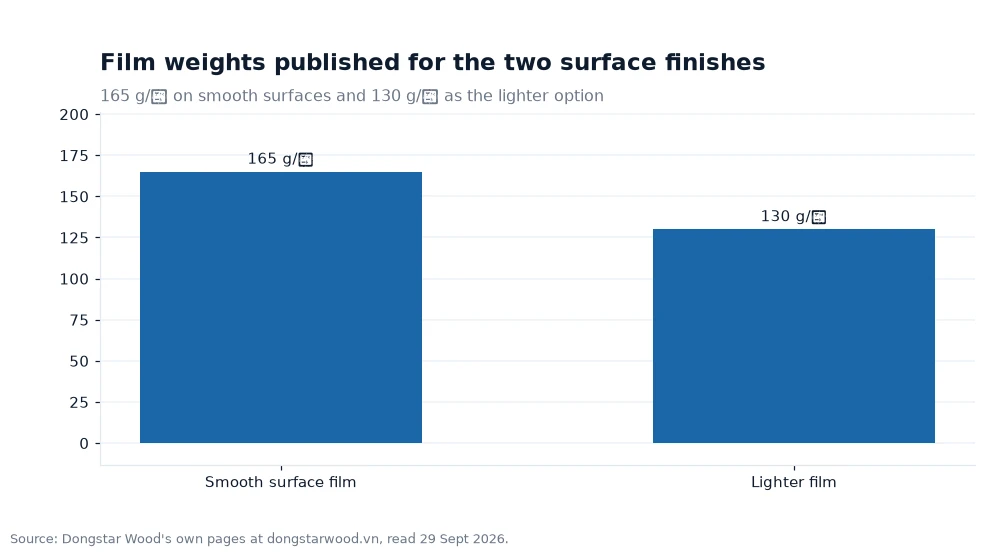
A European contractor's formwork plywood specification is a document before it is a price. Dongstar Wood publishes the inputs that document is built from: film weights of 165 g/㎡ on smooth surfaces and 130 g/㎡ as the lighter option, reuse of up to 10–20 times for high-grade panels, thicknesses of 18 mm and 21 mm and above, and in-house lab testing from raw materials to export batch. Expectations are easier to meet when they are read as numbers.

Key takeaways
- Two film weights are published: 165 g/㎡ on smooth surfaces and 130 g/㎡ as the lighter option.
- Reuse is quoted at up to 10–20 times for high-grade panels, which turns the purchase into a cost per pour.
- Heavy formwork takes 18 mm boards; bridge decks and high-load platforms take 21 mm or more.
- Documentation expectations include CE, EUDR due diligence and emission classes, backed by in-house lab testing.
The two published film weights
The category page publishes film weight rather than leaving it to the datasheet: 165 g/㎡ on smooth surfaces and 130 g/㎡ as the lighter option. The heavier film is the default for demanding positions, where the panel is stripped and re-fixed many times and the surface has to survive contact with concrete, form oil and the weather between pours. The phenolic film surface resists that contact. The lighter film suits positions where the panel is handled more gently and the reuse count sits at the lower end of the range.
For a contractor, the film weight is a durability input to the budget, not a cosmetic detail. A panel that loses its film mid-programme fails at the worst moment: a pour is scheduled, the crew is on site, and the panel that should be in the formwork is being scraped. Specifying the film weight that matches the position is cheaper than explaining a delayed pour, and it is a number that can be checked on delivery against the published figure.
Reuse cycles as a budgeting input
On the product page, high-grade film faced plywood is listed as capable of 10–20 reuse cycles in concrete pouring work. That range is the single most useful number a contractor can put into a budget, because it converts a panel purchase into a cost per pour: a sheet reused ten times costs a tenth as much per pour as a single-use sheet, before any price negotiation happens. The range depends on edge and surface maintenance, so the sites that reach the upper end are the ones that treat edge sealing and face cleaning as part of the cycle.
The reuse expectation also shapes the thickness choice. A panel that will be reused twenty times is specified differently from a panel that will be reused three times: the first takes the heavier film and the denser core, the second can take the lighter options. Matching the specification to the expected reuse count is how a contractor keeps the budget honest, and it is a conversation that happens at the specification stage, not at the invoice stage.
Thickness and load: 18 mm against 21 mm and above
Thickness follows the load. Eighteen millimetres is quoted for heavy formwork and as the overall standard choice, which covers the wall and column panels that make up most of a floor cycle. Panels at 21 mm or thicker are recommended for bridge decks and high-load platforms, where the panel spans further and carries more than wet concrete. The split is not arbitrary: it is the difference between a panel that is held around its edges and a panel that is a platform.
Contractors working at height must also account for handling. A panel that is correct for the load but wrong for the crew slows the cycle and creates the kind of improvisation that leads to accidents. The published sizes — 1220 × 2440 mm, 1250 × 2500 mm, 1500 × 3000 mm and custom up to 1830 × 3830 mm — exist to balance coverage against handling, and the size expectation is part of the same conversation as the thickness.
Core and adhesive options contractors ask for
The core options listed are birch, eucalyptus, acacia, white hardwood, rubber and combi, and the adhesive range includes E0, E1, E2, MR, WBP and Phenolic Dynea. For formwork the structural conversation is about the exterior grades: WBP and phenolic systems that preserve the veneer bonds through repeated wetting and stripping. The interior grades appear in the same list because the category serves interior buyers too, and the glue class is one more line where the specification has to match the job.
The core conversation follows the load path. Acacia brings density and load-bearing capacity, eucalyptus brings compression resistance and bending performance, white hardwood brings stability and cost-performance, and combi balances all three. A contractor who knows the load path can specify the core with confidence; one who does not is specifying by habit, and habit is not a specification.
The documentation a site pack expects
European site packs are document-driven, and the expectations are exacting. CE documentation covers the construction product side. EUDR requires a due-diligence statement connecting the consignment to its supply area, and the home page presents the company as EUDR-ready. Emission classes E0 and CARB P2 appear where panels end up in interior applications with tight emission limits. The manufacturer lists six schemes in total — ISO, CE, SGS, FSC, EUDR and BSCI — and each answers a different question in the pack.
Behind the documentation sits the testing claim: lab testing covers raw materials through export batch, with batch inspection items including panel thickness consistency and core construction integrity. A Film Faced Plywood order that arrives with its batch reference, glue class and face grade documented can be verified against the sample that was approved months earlier; an order that arrives without them cannot, and the check becomes an argument.
| Expectation | Published input | Where it is checked |
|---|---|---|
| Surface durability | 165 g/㎡ smooth film; 130 g/㎡ lighter | On delivery, against the published figure |
| Reuse | Up to 10–20 times, high grade | Through edge and surface maintenance |
| Load | 18 mm heavy formwork; 21 mm+ platforms | Against the load path of the structure |
| Traceability | EUDR due-diligence statement | In the site pack with CE documents |
| Consistency | In-house lab testing, batch inspection | Panel thickness and core construction |
Worked example: film mass and contact area
Example: a 1250 × 2500 mm panel provides 1.25 m × 2.5 m = 3.125 m². At the published 165 g/㎡ smooth film, one face carries 165 × 3.125 = 515.625 g of film. A stack of twenty panels therefore carries about 20 × 515.625 = 10,312.5 g, or roughly 10.3 kg, of surface protection into the formwork.
Example: the reuse arithmetic follows the same area. At fifteen reuses, one sheet delivers 15 × 3.125 = 46.875 m² of poured surface. A slab formwork of 200 m² therefore needs about 200 ÷ 46.875 = 4.27, so roughly five sheets at fifteen reuses each. Each step is a planning estimate on published figures, labelled as an example, and neither is a delivery commitment.
Frequently asked questions
When is the 130 g/㎡ film the right choice?
The page publishes 165 g/㎡ for smooth surfaces and 130 g/㎡ as the lighter option. The lighter film suits panels where the surface is protected during handling and the pour count sits at the lower end of the reuse range.
What do contractors check before accepting a delivery?
The checks named on the product pages are panel thickness consistency and core construction integrity, both confirmed by in-house lab testing from raw materials to export batch. A batch reference and glue class should travel with the sample.
How does EUDR affect a formwork order?
It adds traceability paperwork to the consignment. A due-diligence statement linking the batch to its supply area belongs in the site pack alongside the CE and emission documentation.
From expectations to a site pack
Expectations become a site pack when each one is attached to a number and a document. The wire mesh product page covers the anti-slip positions where crews stand, and the company's own profile sets out the certification set and the factory behind the numbers. With film weight, reuse, thickness and documentation fixed, the formwork order that comes back can be checked line by line against the specification the contractor actually wrote.
Details cited in this article trace to the supplier's published pages consulted on 29 September 2026[1].